
Cardiac Surgery for Botswana Patients in India
Complete Clinical & Surgical Guide — conditions, procedures, risks, recovery and the Botswana-to-India treatment pathway.
 Botswana
Quick Navigation
In Brief
Botswana patients considering cardiac surgery in India should first establish the exact diagnosis and whether surgery is genuinely required, since many conditions can be managed with medication or angioplasty alone. When surgery is appropriate, the treatment should be matched to the exact cardiac pathology, supported by a clear recovery timeline, a transparent cost comparison, and a confirmed plan for fit-to-fly clearance and follow-up care back in Botswana.
What Is Cardiac Surgery?
Cardiac surgery and interventional cardiology cover procedures performed on the heart muscle, coronary arteries, heart valves, the electrical conduction system, and the major vessels leaving the heart. The objective depends entirely on the underlying diagnosis: restoring blood flow to a blocked artery, repairing or replacing a damaged valve, correcting a structural or congenital defect, controlling a dangerous heart rhythm, or supporting a failing heart. Cardiac treatment is therefore not one operation — when considering cardiac surgery for Botswana patients in India, the appropriate approach depends heavily on the exact diagnosis, the anatomy involved, and how the heart muscle itself is functioning.
Common Cardiac Conditions for Which Botswana Patients May Consider Treatment in India
Coronary Artery Disease (CAD)
Narrowing or blockage of the coronary arteries reduces blood flow to the heart muscle, causing chest pain (angina), breathlessness or, if a blockage is severe, a heart attack. Treatment ranges from medication to angioplasty with stenting to coronary artery bypass grafting, depending on the number, location and severity of blockages.
Heart Valve Disease
Valves that have become narrowed (stenosis) or leaky (regurgitation) — most often the mitral or aortic valve — can cause breathlessness, fatigue, palpitations or fluid retention. Some valves can be repaired; others require replacement with a mechanical or tissue valve.
Congenital Heart Defects (Adult)
Some Botswana patients carry a structural heart defect from birth that was never corrected, or was corrected in childhood and now requires reassessment. India has centres experienced in adult congenital heart disease.
Heart Failure
When the heart muscle can no longer pump effectively, patients may experience breathlessness, swelling and fatigue. Depending on the cause, treatment can range from optimised medication to device therapy or, in selected cases, surgery.
Arrhythmias (Abnormal Heart Rhythm)
Irregular heartbeats such as atrial fibrillation or dangerous ventricular rhythms may require medication, catheter ablation, or an implanted device such as a pacemaker or defibrillator.
Aortic Aneurysm or Dissection
Weakening or tearing of the aorta's wall can be life-threatening and may require urgent or planned surgical repair, depending on size, location and stability.
Cardiomyopathy
Diseases of the heart muscle itself — whether from long-standing high blood pressure, viral illness, genetic causes or other factors — can weaken the heart's pumping ability over time.
Does Every Condition Need Surgery?
No. This is one of the most important principles of cardiac surgery for Botswana patients in India. Depending on the diagnosis, appropriate non-surgical treatment may include:
- Optimised medication (blood pressure, cholesterol, rhythm-control or heart-failure drugs)
- Lifestyle modification (diet, smoking cessation, structured exercise)
- Cardiac rehabilitation
- Angioplasty and stenting instead of open surgery, where suitable
- Regular monitoring rather than immediate intervention for stable, low-risk disease
A blockage or a leaking valve seen on an angiogram or echocardiogram does not automatically mean surgery is necessary. A cardiologist and cardiac surgeon should jointly evaluate whether the patient's symptoms, test results and overall risk profile justify intervention, and which type.
When May Surgery Be Recommended?
- Severe or multi-vessel coronary artery blockage, especially involving the left main artery
- Angina that persists despite optimal medication
- Significant valve stenosis or regurgitation with symptoms or declining heart function
- Aortic aneurysm above a critical size, or any dissection
- Heart failure not responding to medical therapy where a structural cause can be corrected
- Certain congenital defects affecting heart function or causing symptoms
- Dangerous arrhythmias not controlled by medication
Warning Signs Botswana Patients Should Not Ignore
- Chest pain or pressure, especially spreading to the arm, jaw or back
- Sudden severe breathlessness
- Fainting or near-fainting episodes
- A very fast, very slow or markedly irregular heartbeat with symptoms
- Sudden severe tearing chest or back pain (possible aortic dissection)
- Rapid swelling of the legs or abdomen with breathlessness
A patient with an acute cardiac emergency should seek immediate local emergency care in Botswana rather than delaying to arrange overseas treatment.
Tests Required Before Cardiac Surgery for Botswana Patients in India
Electrocardiogram (ECG)
Records the heart's electrical activity and can identify rhythm problems or prior heart attacks.
Echocardiogram
An ultrasound of the heart showing valve function, muscle pumping strength and chamber size.
Coronary Angiogram / CT Coronary Angiogram
Maps the coronary arteries directly to identify blockages and their severity.
Blood Tests
Including cardiac markers, kidney and liver function, coagulation, blood sugar and cholesterol profile.
Stress Testing
Assesses how the heart performs under exertion, useful when symptoms are not clear-cut at rest.
Pulmonary and Anaesthesia Assessment
Additional lung function or anaesthesia evaluation may be required depending on age and overall health.
Major Types of Cardiac Surgery for Botswana Patients in India
Angioplasty and Stenting (PCI)
A catheter-based procedure that opens a blocked artery and places a stent to keep it open. Performed without open surgery, often with a short hospital stay.
Coronary Artery Bypass Grafting (CABG)
A surgeon creates new routes for blood flow around blocked coronary arteries using a vessel graft, typically for multi-vessel disease or when stenting is not appropriate.
Valve Repair Surgery
The patient's own valve is reconstructed rather than replaced, where anatomy allows — often preferred when feasible because it preserves natural valve function.
Valve Replacement Surgery
A damaged valve is replaced with a mechanical or tissue (biological) valve. The choice depends on age, lifestyle, bleeding risk and suitability for long-term blood thinners.
Transcatheter Aortic Valve Implantation (TAVI/TAVR)
A catheter-based way to replace the aortic valve without open-heart surgery, suitable for selected patients, particularly those at higher surgical risk.
Off-Pump vs. On-Pump Bypass Surgery
Traditional (on-pump) CABG uses a heart-lung machine to temporarily take over circulation while the heart is stopped. Off-pump (beating-heart) CABG is performed while the heart continues beating, avoiding the heart-lung machine in appropriately selected patients. Neither approach is universally superior — the right choice depends on the number and location of blockages, the patient's overall condition, and the surgeon's experience with each technique.
Minimally Invasive and Robotic-Assisted Cardiac Surgery
Advanced Indian cardiac centres may offer minimally invasive valve surgery, robotic-assisted procedures, hybrid cardiac catheterisation labs and advanced imaging. These technologies can reduce incision size and potentially shorten recovery in appropriately selected patients, but they do not replace the fundamentals of correct diagnosis and surgical judgement. A useful question for Botswana patients is not “Does this hospital have a cardiac robot?” but “Will this technology materially improve the safety or outcome of my specific procedure?”
Risks and Possible Complications of Cardiac Surgery for Botswana Patients in India
- Bleeding requiring transfusion or re-operation
- Infection, including at the incision or in the chest cavity
- Irregular heart rhythm after surgery
- Stroke
- Kidney injury
- Blood clots
- Graft or valve-related complications over time
- Need for a permanent pacemaker in selected cases
- Anaesthesia-related complications
- Prolonged ventilator or ICU dependence in complex cases
The risk profile of a straightforward single-vessel angioplasty is very different from that of complex multi-vessel bypass combined with valve surgery. Patients should request procedure-specific risk information rather than relying on generic complication percentages.
How Much Does Cardiac Surgery for Botswana Patients in India Cost, and How Does It Compare?
Cardiac treatment does not have one standard price, and cardiac surgery in India for Botswana patients is no exception. Indicative private-hospital ranges vary by procedure, number of vessels or valves involved, devices used and hospital category — but India consistently compares favourably against both private treatment in Botswana and South Africa.
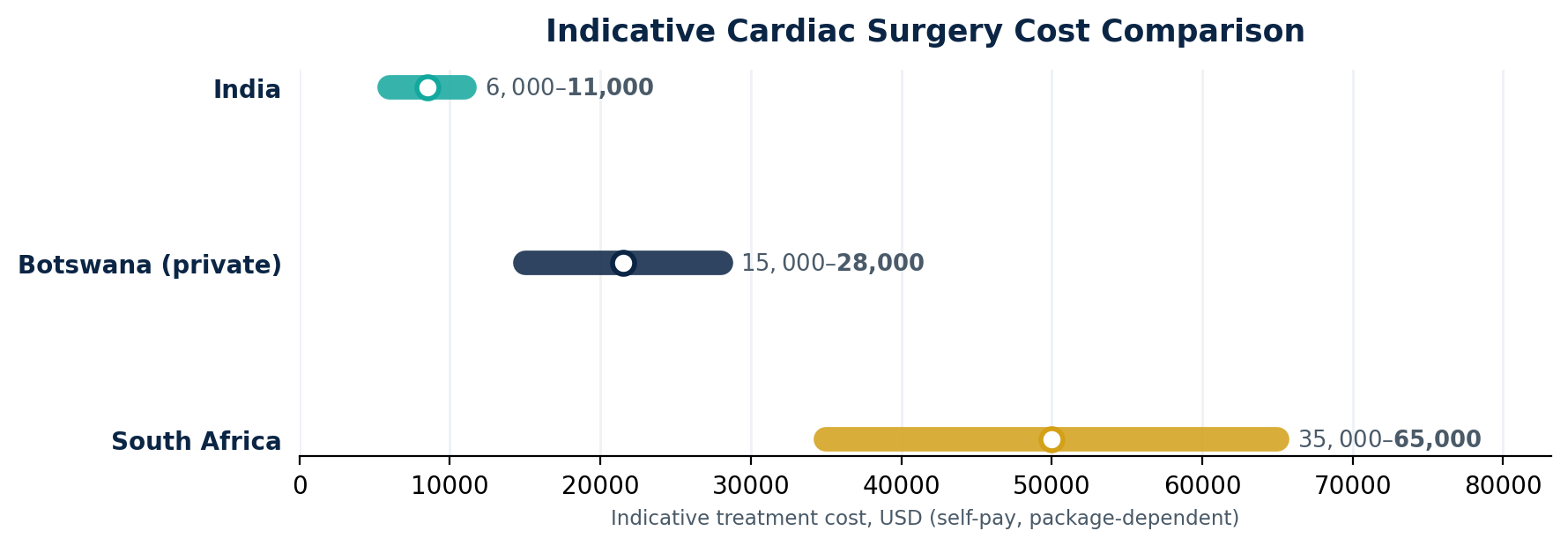
A lower headline price can sometimes become more expensive if the quotation excludes devices, ICU days, or postoperative care. Always request a written, itemised quotation before comparing hospitals, and compare the complete treatment package rather than a single advertised figure.
For procedure-wise price ranges, package inclusions and how to compare quotations, read our Cardiac Surgery Cost in India for Botswana Patients guide.
Choosing the Right Surgeon, Cardiologist and Hospital
Should I choose a hospital based on its technology alone? No. Technology — including robotic platforms and hybrid catheterisation labs — is one component of good cardiac care, but procedure-specific surgeon and team experience, correct diagnosis, and postoperative cardiac care remain fundamental. A famous hospital name or an advanced device should never be the sole reason for choosing a centre; the clinically appropriate solution for an individual patient's heart condition matters more.
When planning cardiac surgery for Botswana patients in India, it is reasonable to ask, before agreeing to treatment, how frequently the surgeon performs the exact procedure being recommended, whether the hospital has a dedicated cardiac ICU and catheterisation lab appropriate to the case, and how communication and follow-up will be handled for an international patient.
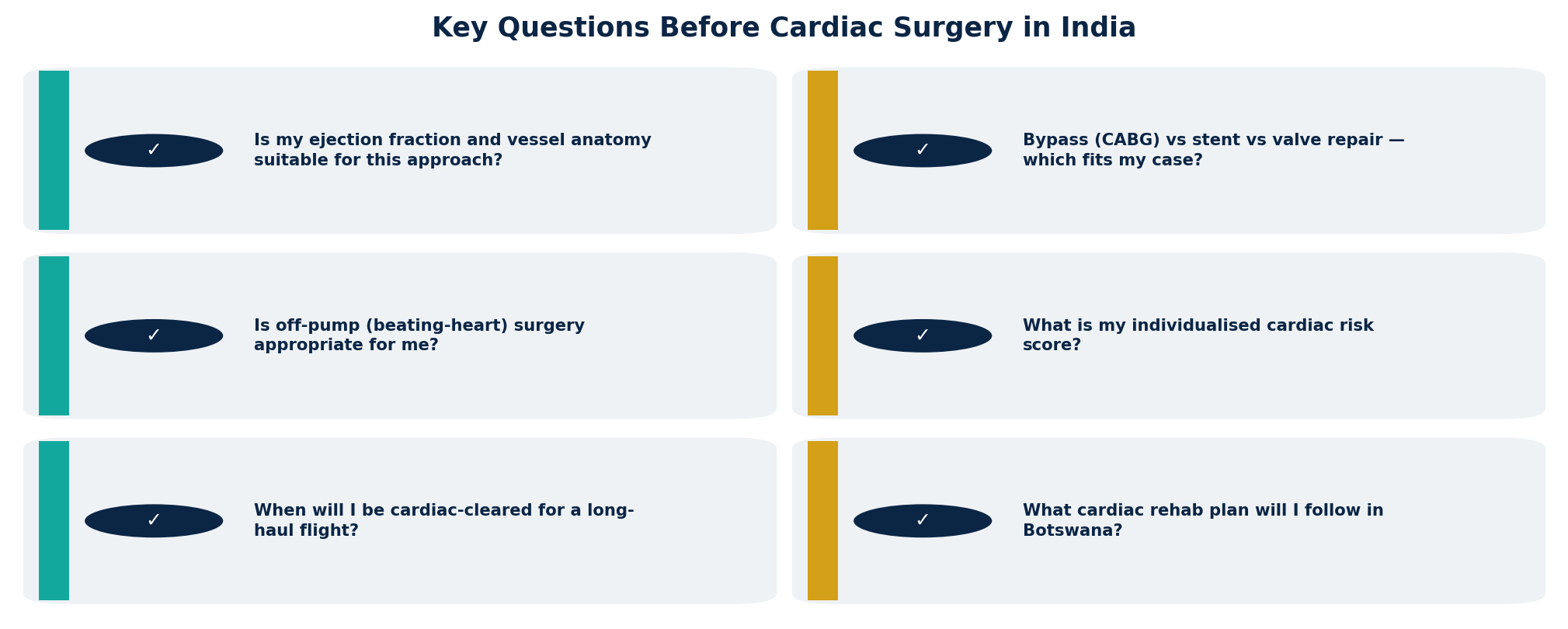
Questions Botswana Patients Should Ask Before Agreeing to Surgery
- What is my exact cardiac diagnosis, and which test confirms it?
- Do I need a stent, bypass surgery, valve repair, or valve replacement?
- What is my ejection fraction, and how does it affect my risk?
- Are there reasonable non-surgical alternatives?
- Which specific procedure do you recommend and why?
- Is off-pump or minimally invasive surgery appropriate for me?
- What are the major risks in my specific case?
- How frequently does this surgeon perform this exact procedure?
- How long will I be hospitalised, and how long in India afterward?
- When will I be cardiac-cleared to fly back to Botswana?
- What cardiac rehabilitation plan will I follow after returning home?
- What blood-thinner or long-term medication will I need, and for how long?
For a complete checklist on choosing a cardiac team, read our Best Cardiac Surgeons and Hospitals in India for Botswana Patients guide.
Recovery, Rehabilitation and the Journey Home
Early Phase
- Pain control
- Heart-rhythm and wound monitoring in ICU/step-down unit
- Early mobilisation once stable
- Breathing exercises to prevent lung complications
- Gradual reduction of monitoring lines and drains
Following Weeks
- Progressive walking and light activity
- Cardiac rehabilitation when advised
- Wound care
- Medication adjustment
- Monitoring for rhythm or fluid-balance issues
Longer-Term Recovery
Patients undergoing bypass or valve surgery typically need several weeks before resuming normal activity and several months for full recovery of stamina, with cardiac rehabilitation continuing well beyond discharge.
Cardiac Rehabilitation
- Supervised walking programmes
- Breathing and lung-clearance exercises
- Gradual exertion increases
- Risk-factor management (diet, smoking cessation)
- Return-to-activity and return-to-work planning
- Long-term monitoring of heart function
When Can Patients Return to Work?
This depends on both the procedure and occupation. A patient with a desk-based role after uncomplicated angioplasty may return within days to weeks, while someone with a physically demanding job after open bypass or valve surgery may need two to three months.
How Long Should a Botswana Patient Remain in India After Cardiac Surgery?
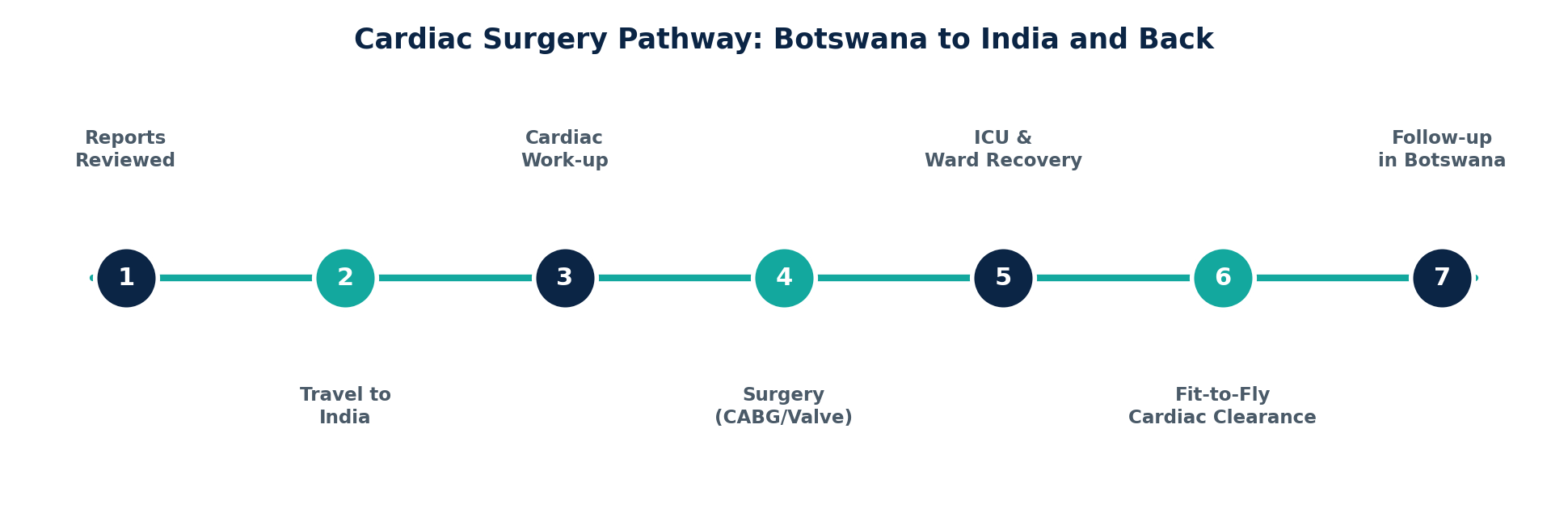
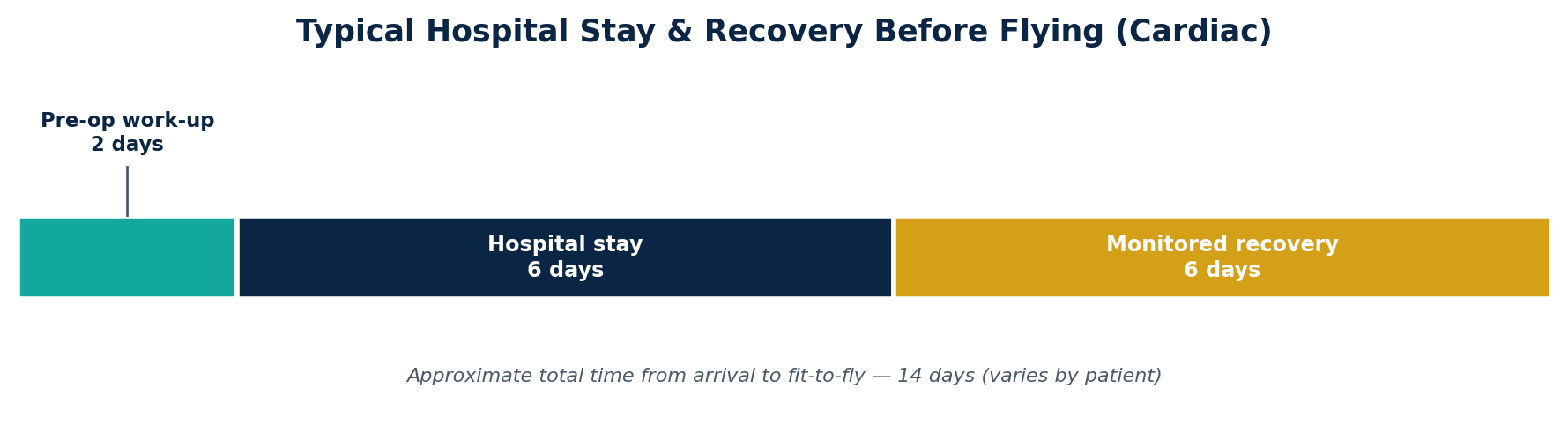
After cardiac surgery for Botswana patients in India, the appropriate period varies significantly by procedure and should take into account wound healing, rhythm stability, ability to walk independently, medication stabilisation and the length of the return journey. A Botswana patient should not book an inflexible return flight based solely on the expected hospital discharge date — being medically ready to leave hospital and being fit for long-distance air travel with a recovering heart are not always the same thing.
Flying Back to Botswana After Cardiac Surgery
- Cardiac fit-to-fly clearance from the treating cardiologist/surgeon
- Rhythm stability confirmation
- Walking during the journey to reduce clot risk
- Hydration and blood-clot prevention measures
- Compression stockings if appropriate
- Medication timing across time zones
- Airport wheelchair assistance if needed
- Suitable seating and avoiding heavy lifting
What Medical Information Should You Take Back to Botswana?
- Discharge summary and operative report
- Final diagnosis
- Echocardiogram and angiogram images/reports
- Laboratory results
- Implant/device details (valve type, stent details, pacemaker card if applicable)
- Medication list and cardiac rehabilitation instructions
- Follow-up schedule and emergency warning signs
- Treating cardiologist/surgeon's contact and follow-up pathway
Follow-Up After Returning to Botswana
- Wound assessment
- ECG and echocardiogram review
- Blood tests (including anticoagulation monitoring if on blood thinners)
- Cardiac rehabilitation progression
- Medication review
- Assessment of valve/graft function over time and return-to-work planning
How Successful Is Cardiac Surgery for Botswana Patients in India?
There is no meaningful single “success rate” for cardiac surgery in India for Botswana patients — or for any patient. Outcomes depend on the underlying diagnosis, heart-muscle function before surgery, number of vessels or valves involved, age, diabetes, kidney function, smoking history, previous cardiac procedures, and rehabilitation. Patients should be cautious about websites offering one universal success percentage.
Cardiac Surgery FAQs for Botswana Patients in India
Does a blocked artery always require bypass surgery for Botswana patients?
No. Many blockages are treated with medication or angioplasty and stenting. Bypass surgery is usually considered for extensive multi-vessel disease or specific anatomical patterns. When assessing cardiac surgery for Botswana patients in India, angiogram findings guide whether bypass is truly needed.
Is minimally invasive heart surgery better than open surgery for Botswana patients?
Not automatically. It can offer benefits for appropriately selected procedures, but complex disease may be better treated through a traditional approach. For cardiac surgery for Botswana patients in India, the approach should be chosen case by case.
How soon is flying home safe for Botswana patients after cardiac surgery in India?
There is no universal timeframe. After cardiac surgery for Botswana patients in India, the cardiologist and surgeon should clear the patient based on rhythm stability, wound healing, and overall recovery.
Can cardiac rehabilitation continue at home for Botswana patients?
Usually, yes. After cardiac surgery for Botswana patients in India, the Indian treating team should provide a rehabilitation protocol that can be shared with a doctor or physiotherapist in Botswana.
Is technology alone the right way to choose a hospital for Botswana patients?
No. Technology is one component. When choosing a centre for cardiac surgery for Botswana patients in India, procedure-specific surgeon and team experience, correct diagnosis, and postoperative cardiac care remain fundamental.
Key Takeaway for Botswana Patients
- Choosing cardiac surgery for Botswana patients in India is a major decision, particularly because postoperative recovery is followed by a long journey home.
- The most important step is establishing the correct diagnosis and determining whether surgery is genuinely required, and of what type.
- When surgery is appropriate, match the treatment to the exact cardiac pathology — stenting when a stent will do, bypass or valve surgery when structurally necessary.
- Use advanced technology only when it offers a meaningful, case-specific benefit.
- The treatment plan should extend beyond the operating room — recovery in India, cardiac fitness for long-distance travel, rehabilitation in Botswana, and a clear follow-up pathway after returning home.
Sources & Further Reading
The following government and medical-authority resources provide independent, publicly available information on this topic:
- Coronary Artery Bypass Grafting
- Cardiovascular diseases (CVDs)
- Heart Health Information
- About Heart Disease
- Heart Valve Diseases
Hero photo: “Health Health - Stethoscope” by Formulate Health, via Wikimedia Commons, licensed CC BY 2.0.
Citation Block: Cardiac Surgery for Botswana Patients in India
Quick reference for Botswana patients and families
| Topic | Information |
|---|---|
| Guide | Cardiac Surgery in India for Botswana Patients — Complete Clinical & Surgical Guide |
| First Step | A confirmed diagnosis — many heart conditions are managed with medication or angioplasty, not surgery |
| Procedures Covered | Bypass (on-pump and off-pump), valve repair/replacement, angioplasty and stenting, minimally invasive and robotic-assisted surgery |
| Key Specialists | Cardiac Surgeon and Interventional Cardiologist |
| Indicative Cost | India US$6,000–11,000 · Botswana (private) US$15,000–28,000 · South Africa US$35,000–65,000 |
| Hospital Stay | About 6–8 days after major cardiac surgery, followed by monitored recovery before flying |
| Choosing a Centre | Surgeon’s experience in the exact procedure, dedicated cardiac ICU and cath lab, clear international-patient follow-up |
| Returning to Botswana | Cardiac fit-to-fly clearance, a flexible return flight and complete medical records |
| Follow-Up in Botswana | Wound check, ECG and echo review, blood tests and cardiac rehabilitation |
| Authored and Reviewed by | Medical Experts at India Cardiac Surgery Team · 05-10-2026 |
Botswana Patients: Plan Your Heart Surgery in India
Bypass, valve surgery or angioplasty — get a FREE CONSULTATION and a US$ cost estimate today.