
Paediatric Cardiac Surgery for Tanzania Patients in India
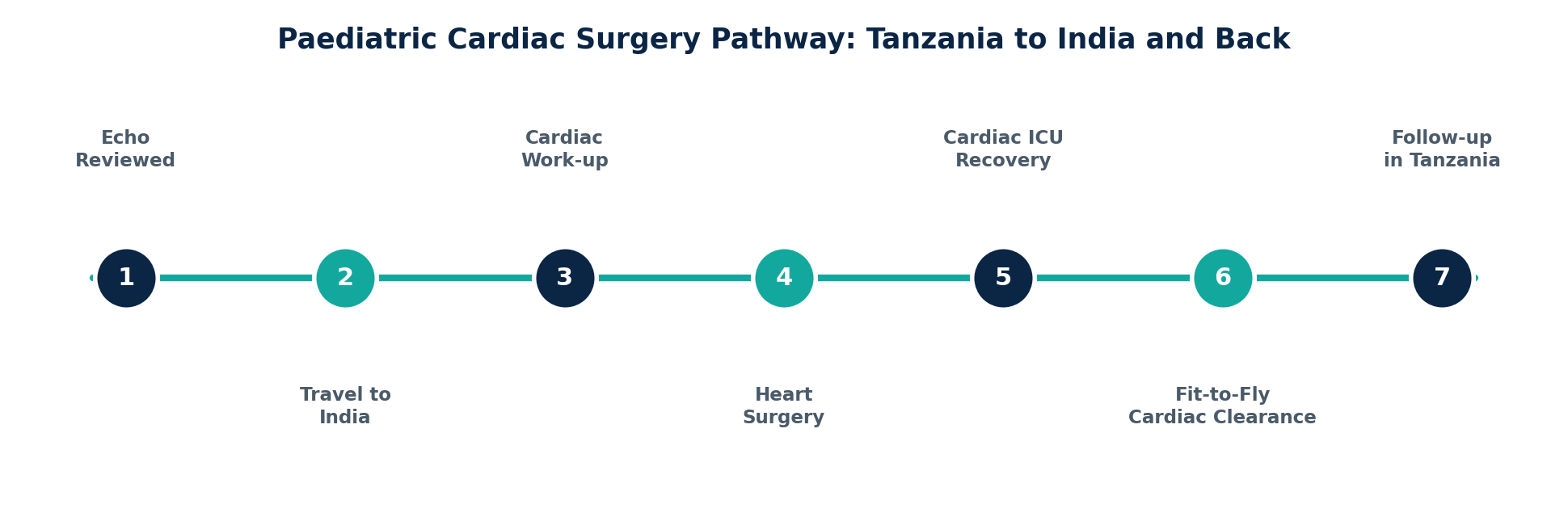
Complete Clinical & Surgical Guide — a practical guide for families travelling from Tanzania to India.
 Tanzania
In Brief
For families in Tanzania whose child has been diagnosed with a congenital heart defect, finding an experienced paediatric cardiac surgical team is one of the most important decisions a parent will make. India has dedicated paediatric cardiac centres performing a full range of procedures for congenital heart disease, from catheter-based interventions to complex open-heart surgery in infants and children, supported by paediatric cardiac intensive care units.
For a family travelling from Tanzania, the important question is not simply “Can this be treated in India?” The more useful questions are: What exactly is my child’s heart defect? Is surgery needed now, or can it wait? What are the risks specific to my child’s age and condition? How long will recovery take? And when will my child be fit enough to make the journey back to Tanzania? This guide explains the clinical aspects of paediatric cardiac surgery in India from the perspective of Tanzania families.
Clinical GuideWhat Is Paediatric Cardiac Surgery for Tanzania Patients in India?
Paediatric cardiac surgery treats congenital heart defects — structural problems with the heart present from birth — as well as some acquired heart conditions in children, such as those following rheumatic fever or Kawasaki disease. The objective and timing depend entirely on the specific defect: some conditions require urgent correction in the newborn period, others can be monitored and treated later in childhood, and some are treated with catheter-based procedures rather than open surgery.
Common Conditions for Which Tanzania Families May Consider Paediatric Cardiac Surgery in India
Ventricular and Atrial Septal Defects (VSD/ASD)
Holes between the heart’s chambers are among the most common congenital heart defects; some close on their own, others require catheter-based closure or surgery.
Tetralogy of Fallot
A combination of four structural heart abnormalities requiring surgical repair, usually in infancy.
Patent Ductus Arteriosus (PDA)
A persistent connection between two major blood vessels that may require closure, often via a catheter-based procedure.
Transposition of the Great Arteries
A serious condition requiring specialised surgical correction, typically soon after birth.
Coarctation of the Aorta
A narrowing of the aorta that can be treated surgically or, in some cases, with a catheter-based procedure.
Single Ventricle Conditions (e.g. Hypoplastic Left Heart Syndrome)
Complex defects usually requiring a staged series of operations over the first few years of life.
Valve Abnormalities
Congenital narrowing or leakage of heart valves, treated according to severity and the child’s age.
Does Every Condition Need Surgery for Tanzania Patients in India?
No. Not every congenital heart defect needs immediate surgery. Depending on the diagnosis, appropriate management may include:
- Observation, since some small defects (such as small VSDs) may close on their own
- Medication to manage symptoms while monitoring the defect
- Catheter-based closure instead of open surgery for suitable defects
- Planned surgery for Tanzania families in India at a specific age when it is safest and most effective, rather than immediately
A diagnosis on echocardiogram does not automatically mean immediate surgery is necessary. A paediatric cardiologist and cardiac surgeon should jointly advise on whether intervention is needed, and the optimal timing for your child’s specific defect.
When May Surgery Be Recommended?
- The defect is causing symptoms such as poor growth, breathlessness or feeding difficulty
- The defect is unlikely to close or improve on its own and poses a long-term risk
- There is a critical or urgent defect requiring intervention in infancy
- The child’s growth or oxygen levels are being significantly affected
- A staged surgical plan requires the next planned procedure at a specific age
Warning Signs Tanzania Families Should Not Ignore
- Blue or grey discolouration of the lips or skin (cyanosis)
- Severe difficulty breathing or rapid breathing
- Poor feeding with sweating or breathlessness during feeds
- Failure to gain weight
- Extreme lethargy or unresponsiveness
- Sudden collapse or loss of consciousness
A child showing any of these signs should be taken for immediate emergency care in Tanzania rather than waiting to arrange overseas travel, as these can indicate a critical cardiac emergency.
Tests Usually Required Before Paediatric Cardiac Surgery
Echocardiogram
The primary test for diagnosing congenital heart defects, showing the heart’s structure and function in detail.
Pulse Oximetry
Measures oxygen levels in the blood, important for detecting critical defects.
Chest X-Ray
Provides information about heart size and lung blood flow.
Cardiac Catheterisation
Used in selected cases for detailed assessment or as a treatment for Tanzania families in India itself.
Cardiac MRI or CT
Used in complex cases requiring more detailed anatomical information.
Blood Tests and Growth Assessment
Assess general health and fitness for surgery.
Major Types of Paediatric Cardiac Surgery and Procedures Available in India
Catheter-Based Closure (Device Closure)
A minimally invasive procedure to close certain septal defects or PDA using a catheter, avoiding open-heart surgery in suitable cases.
Open-Heart Surgery for Septal Defects
Surgical closure of larger or complex septal defects not suitable for catheter closure.
Tetralogy of Fallot Repair
Surgical correction of all four structural abnormalities, usually performed in infancy.
Arterial Switch and Complex Reconstructive Surgery
Specialised procedures for conditions such as transposition of the great arteries.
Staged Single-Ventricle Palliation
A planned series of operations (such as the Norwood, Glenn and Fontan procedures) for complex single-ventricle defects.
Valve Repair or Replacement
Correction of congenital valve abnormalities, with repair generally preferred over replacement in children where possible.
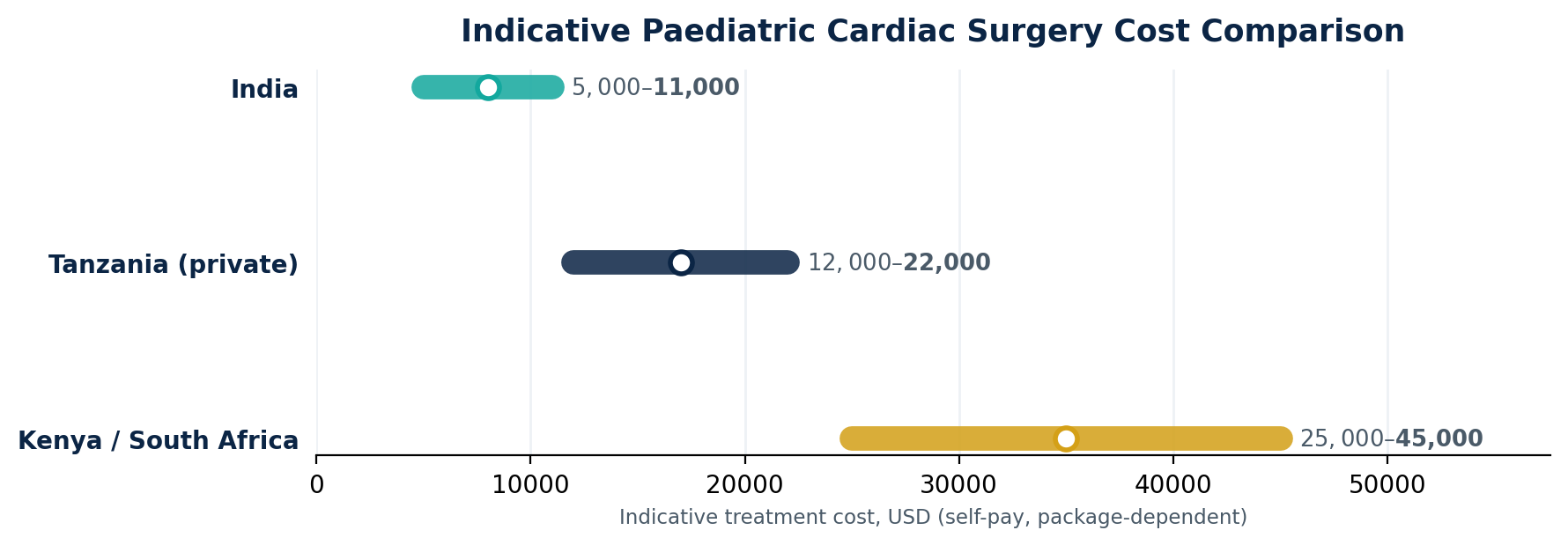
For more detail, read our Paediatric Cardiac Surgery Costs & Treatment Planning for Tanzania Patients in India guide.
Minimally Invasive and Catheter-Based Techniques
Many congenital heart defects that once required open surgery for Tanzania families in India can now be treated with catheter-based device closure, avoiding a chest incision and generally allowing faster recovery. This is not suitable for every defect — the anatomy of the specific defect determines whether a catheter-based approach or open surgery is appropriate.
Paediatric Cardiac Intensive Care and Anaesthesia
Successful paediatric cardiac surgery depends heavily on dedicated paediatric cardiac anaesthesia and postoperative intensive care, alongside the surgery itself. Advanced Indian paediatric cardiac centres provide specialised cardiac ICUs for infants and children. A useful question for Tanzania families is not just “Who is the surgeon?” but “What paediatric cardiac ICU and anaesthesia support is available for my child specifically?”
Risks and Possible Complications of Paediatric Cardiac Surgery for Tanzania Patients in India
- Bleeding requiring transfusion or re-operation
- Infection
- Irregular heart rhythm after surgery
- Stroke
- Residual or recurrent defects requiring further treatment
- Need for a pacemaker in selected cases
- Anaesthesia-related complications
- Prolonged ventilator or ICU dependence in complex cases
- Growth-related need for future revision surgery in some conditions
The risk profile of a simple catheter-based closure is very different from that of complex staged single-ventricle surgery for Tanzania families in India. Parents should request procedure-specific and defect-specific risk information rather than relying on generic complication percentages.
Recovery After Surgery
Early Phase
- Pain control appropriate to the child’s age
- Cardiac monitoring in a paediatric cardiac ICU
- Wound monitoring
- Gradual reduction of monitoring lines and support
- Feeding support as the child stabilises
Following Weeks
- Progressive activity increase
- Growth and feeding monitoring
- Wound care
- Medication adjustment
- Monitoring for rhythm or fluid-balance issues
Longer-Term Recovery
Many children return to normal activity within weeks of straightforward repairs, but those undergoing staged single-ventricle surgery or complex reconstruction require years of planned follow-up procedures and monitoring as they grow.
Recovery Support and Cardiac Follow-Up
- Nutritional support for catch-up growth where needed
- Gentle, age-appropriate activity progression
- Developmental monitoring
- Family education on warning signs at home
- Psychological support for the family
- Long-term paediatric cardiology follow-up
When Can Patients Return to Work?
This section applies to parents/caregivers: time away from work depends on the child’s procedure. A straightforward catheter-based closure may need only a few days of parental leave, while major open-heart surgery for Tanzania families in India or staged single-ventricle procedures typically require several weeks of a parent’s presence for recovery and follow-up.
For more detail, read our Best Paediatric Cardiac Surgeons & Hospitals for Tanzania Patients in India guide.
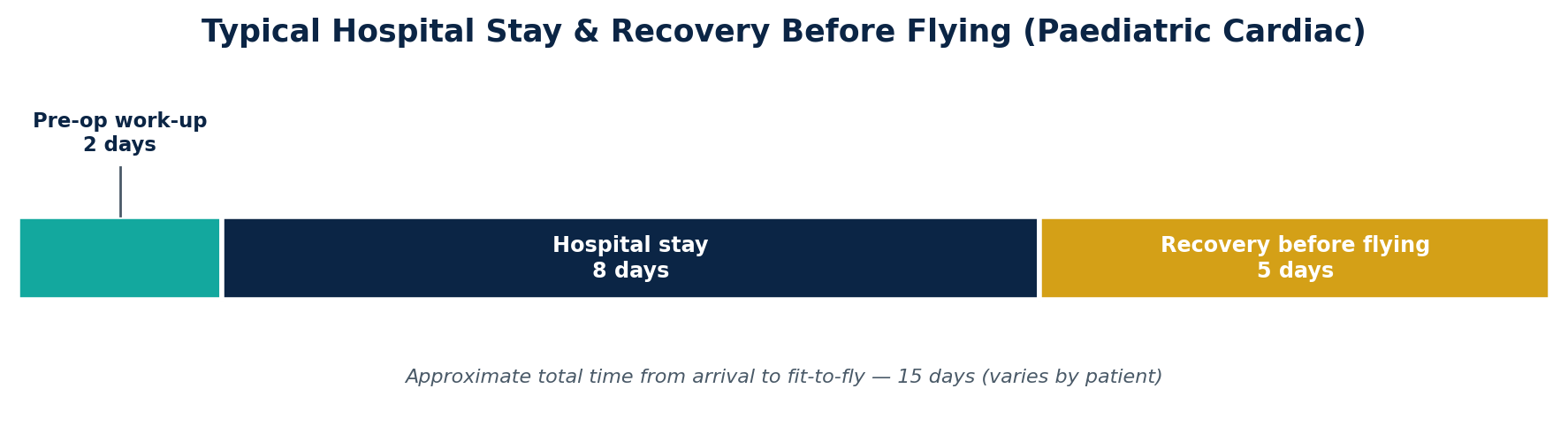
How Long Should a Tanzania Family Remain in India After Paediatric Cardiac Surgery?
The appropriate period depends on the defect, the procedure performed, feeding stability, wound healing, and cardiac stability. A Tanzania family should not book an inflexible return flight based solely on the expected hospital discharge date, since cardiac fitness for a long flight is assessed separately from readiness for hospital discharge.
Flying Back to Tanzania After Paediatric Cardiac Surgery
- Cardiac fit-to-fly clearance from the treating paediatric cardiologist/surgeon
- Oxygen level and feeding stability confirmation
- Wound assessment before flying
- Medication timing
- Comfort items for the child
- Suitable seating and any required medical equipment
- Plan for in-flight monitoring if needed
Infants and children recovering from major heart surgery may need specific clearance regarding cabin pressure changes and oxygen needs before flying.
What Medical Information Should You Take Back to Tanzania?
- Discharge summary
- Operative report
- Final diagnosis
- Echocardiogram and other cardiac imaging
- Growth and feeding records
- Medication list with paediatric dosing
- Device/implant details if applicable
- Follow-up schedule
- Emergency warning signs specific to the condition
- Treating paediatric cardiac team’s contact/follow-up pathway
Follow-Up After Returning to Tanzania
- Echocardiogram review
- Growth and development monitoring
- Medication review
- Coordination with local paediatric cardiologist
- Planning for any staged future surgery for Tanzania families in India
- Long-term cardiac surveillance
How Successful Is This Surgery?
There is no meaningful single “success rate” for paediatric cardiac surgery. Outcomes depend on the specific defect, the child’s age and overall health at the time of surgery, and whether the defect is an isolated problem or part of a more complex condition. The expected outcome of a simple ASD closure cannot
reasonably be compared with staged surgery for a single-ventricle heart. Parents should be cautious about websites offering one universal success percentage.
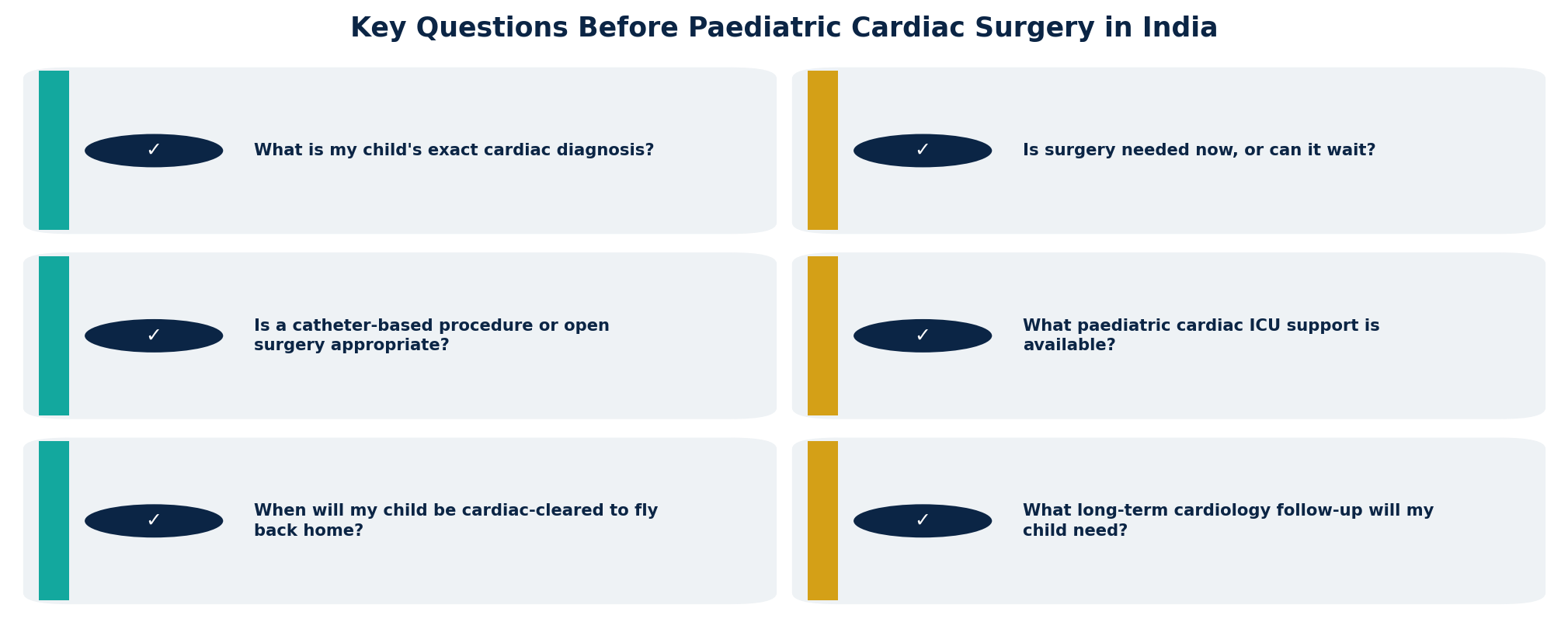
Questions Tanzania Patients Should Ask Before Agreeing to Surgery
- What is my child’s exact cardiac diagnosis?
- Is surgery needed now, or can it wait?
- Is a catheter-based procedure or open surgery appropriate?
- What are the specific risks for my child’s age and defect?
- What paediatric cardiac ICU support is available?
- How frequently does this team treat this exact defect?
- How long will my child be hospitalised, and how long in India afterward?
- When will my child be cardiac-cleared to fly back to Tanzania?
- Will my child need further heart surgery for Tanzania families in India as they grow?
- What long-term cardiology follow-up will my child need?
Paediatric Cardiac Surgery FAQs for Tanzania Families in India
For Tanzania families, can my child’s echocardiogram be reviewed before we travel from Tanzania?
Often, yes. Digital echocardiogram images and reports can frequently be reviewed remotely for an initial opinion, though a definitive plan usually requires in-person evaluation.
Does every congenital heart defect need surgery for Tanzania families?
No. Some small defects close on their own or are treated with catheter-based procedures rather than open surgery.
Is catheter-based closure safer than open-heart surgery for Tanzania families?
It generally involves a shorter recovery, but it is only suitable for certain defects; your paediatric cardiologist will advise which approach fits your child’s specific anatomy.
Will my child need more than one heart surgery for Tanzania families?
Some complex conditions, particularly single-ventricle defects, are treated with a planned series of operations over several years.
For Tanzania families, how soon can we fly back to Tanzania?
There is no universal timeframe. The paediatric cardiac team should clear your child based on cardiac stability, wound healing, and feeding.
Key Takeaway for Tanzania Families
- Travelling from Tanzania to India for paediatric cardiac surgery is one of the most significant decisions a family will make.
- The most important step is obtaining a precise diagnosis and understanding whether surgery is needed now, and whether a catheter-based or surgical approach is right for your child’s specific defect.
- For a Tanzania family, the plan should also address paediatric cardiac ICU and anaesthesia support, recovery in India, fitness for travel, and a clear pathway for long-term cardiology follow-up after returning home.
Sources & Further Reading
The following government and medical-authority resources provide independent, publicly available information on this topic:
- Congenital Heart Defects - Treatment
- About Congenital Heart Defects
- Congenital Heart Defects - Types
- About the Cardiothoracic Surgery Unit
- Cardiovascular diseases (CVDs)
Hero photo: “Health Health - Stethoscope” by Formulate Health, via Wikimedia Commons, licensed CC BY 2.0.
Citation Block: Paediatric Cardiac Surgery for Tanzania Patients in India
Quick reference for Tanzania families
| Topic | Information |
|---|---|
| Guide | Paediatric Cardiac Surgery for Tanzania Patients in India — Complete Clinical & Surgical Guide |
| Overview | Paediatric cardiac surgery treats congenital heart defects — structural problems with the heart present from birth — as well as some. |
| Condition | No. |
| Warning Signs | Blue or grey discolouration of the lips or skin (cyanosis) |
| Minimally Invasive | Many congenital heart defects that once required open surgery for Tanzania families in India can now be treated with catheter-based device. |
| Risks Possible | Bleeding requiring transfusion or re-operation |
| Recovery Support | Nutritional support for catch-up growth where needed |
| Flying Back | Cardiac fit-to-fly clearance from the treating paediatric cardiologist/surgeon |
| Follow-Up Returning | Echocardiogram review |
| Authored and Reviewed by | Medical Experts at India Cardiac Surgery Team · 06-10-2026 |
Tanzania Families: Plan Your Child's Heart Surgery in India
VSD, ASD, TOF or other congenital heart defects — get a FREE CONSULTATION and a US$ cost estimate today.