
Vascular and Endovascular Surgery for United Kingdom Patients in India
Complete Clinical & Surgical Guide — a practical guide for patients travelling from the United Kingdom to India.
 United Kingdom
In Brief
For patients in the United Kingdom living with leg pain from blocked arteries, varicose veins, an aortic aneurysm, carotid artery narrowing, or diabetic foot complications related to poor circulation, surgery or a minimally invasive vascular procedure may become necessary when medication and lifestyle changes are not enough. India offers a full spectrum of vascular and endovascular care — from varicose vein ablation and angioplasty to complex aortic aneurysm repair and bypass surgery — performed in centres with dedicated vascular surgical teams and hybrid catheterisation facilities.
For a patient travelling from the United Kingdom, the important question is not simply “Can this be treated in India?” The more useful questions are: Do I actually need surgery, or can this be managed with medication and risk-factor control? Is a minimally invasive endovascular option appropriate for my anatomy? What are the risks? How long will recovery take? And when will I be fit enough to make the journey back to the United Kingdom? This guide explains the clinical aspects of vascular and endovascular surgery in India from the perspective of United Kingdom patients.
Clinical GuideWhat Is Vascular and Endovascular Surgery for United Kingdom Patients in India?
Vascular surgery covers procedures performed on the arteries and veins outside the heart and brain — including the aorta, the leg and arm arteries, the carotid arteries in the neck, and the venous system. The objective depends on the diagnosis: restoring blood flow to a blocked artery, repairing or replacing a weakened section of the aorta, removing or closing damaged veins, or protecting against stroke by treating narrowed neck arteries. Many of these conditions can now be treated using endovascular techniques — catheter-based procedures performed from inside the blood vessel — rather than traditional open surgery, depending on the anatomy and extent of disease.
Common Vascular Conditions for Which United Kingdom Patients May Consider Treatment in India
Peripheral Arterial Disease (PAD)
Narrowing of the leg arteries reduces blood flow, causing pain on walking (claudication) or, in severe cases, pain at rest and non-healing wounds. Treatment ranges from medication and exercise therapy to angioplasty, stenting, or bypass surgery for United Kingdom patients in India.
Abdominal and Thoracic Aortic Aneurysm
A weakened, bulging section of the aorta can be at risk of rupture if it grows beyond a critical size, and may be repaired either through open surgery or a minimally invasive endovascular stent graft.
Carotid Artery Disease
Narrowing of the carotid arteries in the neck increases stroke risk; treatment may involve medication, carotid endarterectomy (surgical removal of the blockage), or carotid stenting.
Varicose Veins and Chronic Venous Insufficiency
Enlarged, malfunctioning veins can cause pain, swelling, and skin changes in the legs, commonly treated with minimally invasive techniques such as endovenous laser or radiofrequency ablation.
Deep Vein Thrombosis (DVT) and Its Complications
Blood clots in the deep veins can cause swelling and pain, and in some cases require clot-removal procedures in addition to blood-thinning medication.
Diabetic Foot and Critical Limb Ischaemia
Poor circulation combined with diabetes can lead to non-healing foot ulcers or gangrene, sometimes requiring urgent revascularisation to avoid amputation.
Dialysis Access (AV Fistula) Problems
Patients on haemodialysis may need surgical creation or repair of the vascular access used for dialysis.
Vascular Trauma and Malformations
Injury to blood vessels, or congenital vascular malformations, may require specialised surgical or endovascular repair.
Does Every Condition Need Surgery for United Kingdom Patients in India?
No. This is one of the most important principles for a United Kingdom patient considering travelling overseas. Depending on the diagnosis, appropriate non-surgical treatment may include:
- Medication (blood thinners, cholesterol-lowering and blood-pressure drugs)
- Supervised exercise therapy for peripheral arterial disease
- Smoking cessation, which significantly affects vascular disease progression
- Compression therapy for varicose veins or chronic venous insufficiency
- Interval monitoring for small, stable aneurysms below the threshold for repair
A narrowed artery or a small aneurysm seen on a scan does not automatically mean surgery for United Kingdom patients in India is necessary. A vascular specialist should evaluate the severity, symptoms, and growth rate of the condition before recommending intervention, and which type.
When May Surgery Be Recommended?
- Disabling leg pain or pain at rest from peripheral arterial disease not responding to medical therapy
- A non-healing wound or ulcer related to poor circulation
- An aneurysm that has grown beyond the size threshold considered safe to observe
- Significant carotid artery narrowing, particularly with symptoms such as a mini-stroke (TIA)
- Varicose veins causing significant symptoms, skin changes, or complications
- Vascular access failure in a dialysis patient
Warning Signs United Kingdom Patients Should Not Ignore
- Sudden severe abdominal or back pain (possible aneurysm rupture)
- Sudden weakness, numbness, or difficulty speaking (possible stroke or TIA)
- A leg that suddenly becomes cold, pale, and painful (possible acute arterial blockage)
- A non-healing wound with spreading redness or fever
- Sudden severe leg swelling and pain (possible DVT)
A patient with sudden severe pain, stroke-like symptoms, or a suddenly cold and painful limb should seek immediate local emergency care in the United Kingdom rather than delaying to arrange overseas treatment, as these can indicate a vascular emergency.
Tests Usually Required Before Vascular Surgery
Doppler Ultrasound
A first-line, non-invasive test that assesses blood flow in arteries and veins.
CT or MR Angiography
Provides detailed imaging of the blood vessels, essential for planning aneurysm repair or complex angioplasty.
Ankle-Brachial Index (ABI)
A simple test comparing blood pressure in the ankle and arm to assess peripheral arterial disease severity.
Catheter Angiography
An invasive but highly detailed imaging test, sometimes performed at the same time as treatment for United Kingdom patients in India.
Blood Tests
Assess kidney function, clotting, blood sugar and cardiovascular risk factors relevant to vascular disease.
Major Types of Vascular and Endovascular Surgery Available in India
Angioplasty and Stenting
A catheter-based procedure to open a narrowed artery and hold it open with a stent, used in leg, carotid, and other arteries.
Endovascular Aneurysm Repair (EVAR/TEVAR)
A stent graft is placed inside the aorta through the blood vessels to exclude an aneurysm from circulation, avoiding a large open incision in suitable patients.
Open Aneurysm Repair
Traditional surgical replacement of the weakened section of the aorta, sometimes necessary when anatomy is not suitable for an endovascular approach.
Carotid Endarterectomy
Surgical removal of plaque from the carotid artery to reduce stroke risk.
Bypass Surgery
A graft is used to reroute blood flow around a severely blocked artery, typically in the leg.
Endovenous Ablation for Varicose Veins
Laser or radiofrequency energy is used to close off malfunctioning veins from inside, without the need for vein-stripping surgery.
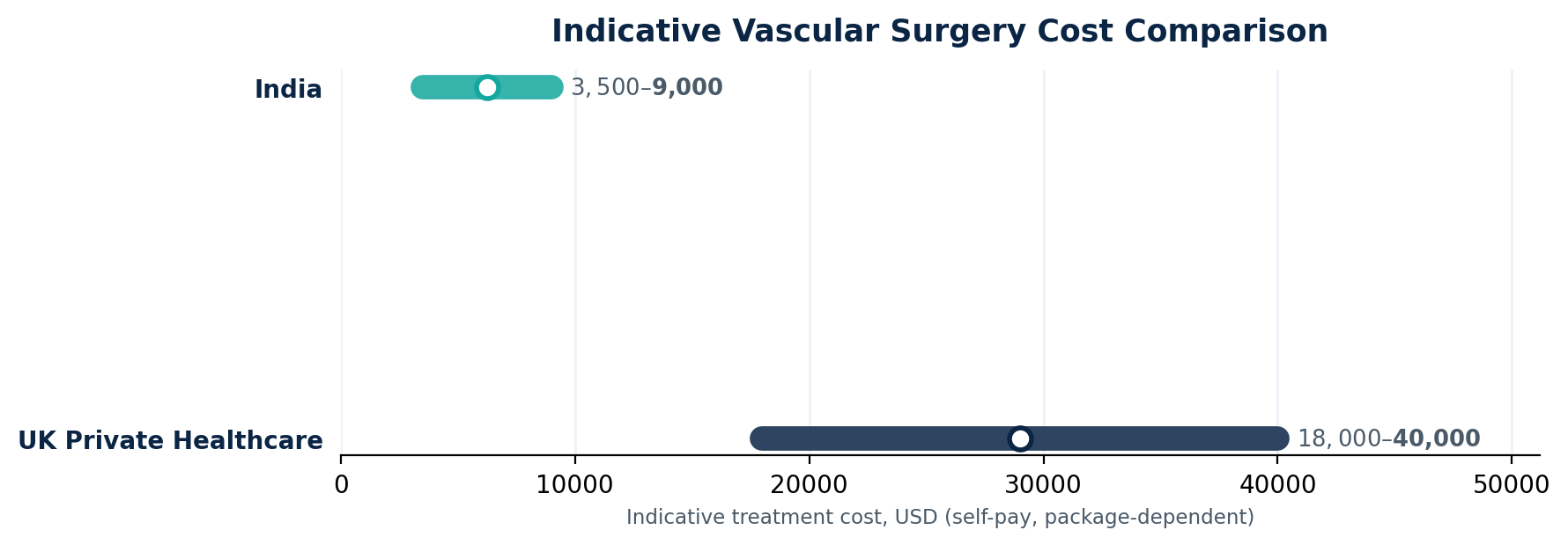
For more detail, read our Vascular and Endovascular Surgery Costs & Treatment Planning for United Kingdom Patients in India guide.
Endovascular vs. Open Surgical Approaches
Many conditions that once required large open incisions — including aortic aneurysms and arterial blockages — can now be treated from inside the blood vessel using catheters, wires and stents. Endovascular treatment for United Kingdom patients in India generally involves smaller incisions, less blood loss, and faster recovery, but is not suitable for every patient; anatomy, the extent of disease, and long-term durability all factor into whether an endovascular or open approach is more appropriate.
Hybrid Operating Rooms and Advanced Imaging
Advanced Indian vascular centres use hybrid operating rooms that combine high-resolution imaging with surgical capability, allowing complex combined open-and-endovascular procedures to be performed safely in a single setting. A useful question for United Kingdom patients is not “Does this hospital have the latest stent graft?” but “Is my specific anatomy suitable for an endovascular approach, and how experienced is this team with this exact procedure?”
Risks and Possible Complications of Vascular Surgery
- Bleeding
- Infection
- Graft or stent-related complications, including blockage over time
- Stroke (particularly with carotid or aortic arch procedures)
- Kidney injury from contrast dye used in imaging
- Limb ischaemia or the need for amputation in severe cases
- Blood clots
- Endoleak (persistent blood flow around a stent graft) after aneurysm repair
- Anaesthesia-related complications
- Need for further intervention or revision surgery
The risk profile of a straightforward varicose vein procedure is very different from that of complex aortic aneurysm repair. Patients should request procedure-specific risk information rather than relying on generic complication percentages.
Recovery After Surgery for United Kingdom Patients in India
Early Phase
- Pain control
- Wound and pulse monitoring
- Early mobilisation where appropriate
- Monitoring for bleeding or limb circulation problems
- Blood-clot prevention measures
Following Weeks
- Progressive walking and activity increase
- Wound care
- Medication adjustment, including blood thinners where relevant
- Risk-factor management (smoking cessation, cholesterol, blood pressure, diabetes control)
- Monitoring of the treated vessel or graft
Longer-Term Recovery
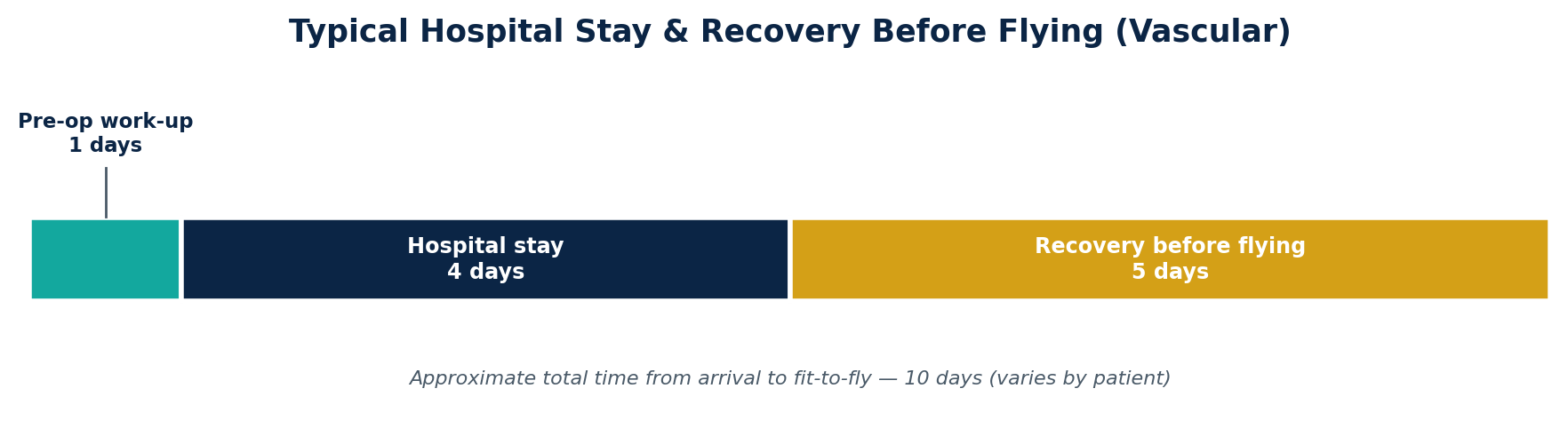
Recovery from endovascular procedures such as angioplasty or varicose vein ablation is typically measured in days, while recovery from open aortic surgery or bypass surgery typically takes several weeks to a few months, with lifelong surveillance often needed after aneurysm repair.
Recovery Support and Risk-Factor Management
- Supervised walking programmes for peripheral arterial disease
- Wound care education for diabetic foot patients
- Compression stocking use where advised
- Smoking cessation support
- Cardiovascular risk-factor management (diet, cholesterol, blood pressure, diabetes)
- Long-term surveillance imaging where relevant (e.g. after aneurysm repair)
When Can Patients Return to Work?
This depends heavily on the procedure and occupation. Minimally invasive procedures such as angioplasty or varicose vein ablation often allow return to desk-based work within days, while open aortic surgery for United Kingdom patients in India or bypass surgery typically requires four to six weeks, longer for physically demanding roles.
For more detail, read our Best Vascular Surgeons & Hospitals for United Kingdom Patients in India guide.
How Long Should a United Kingdom Patient Remain in India After Vascular Surgery?
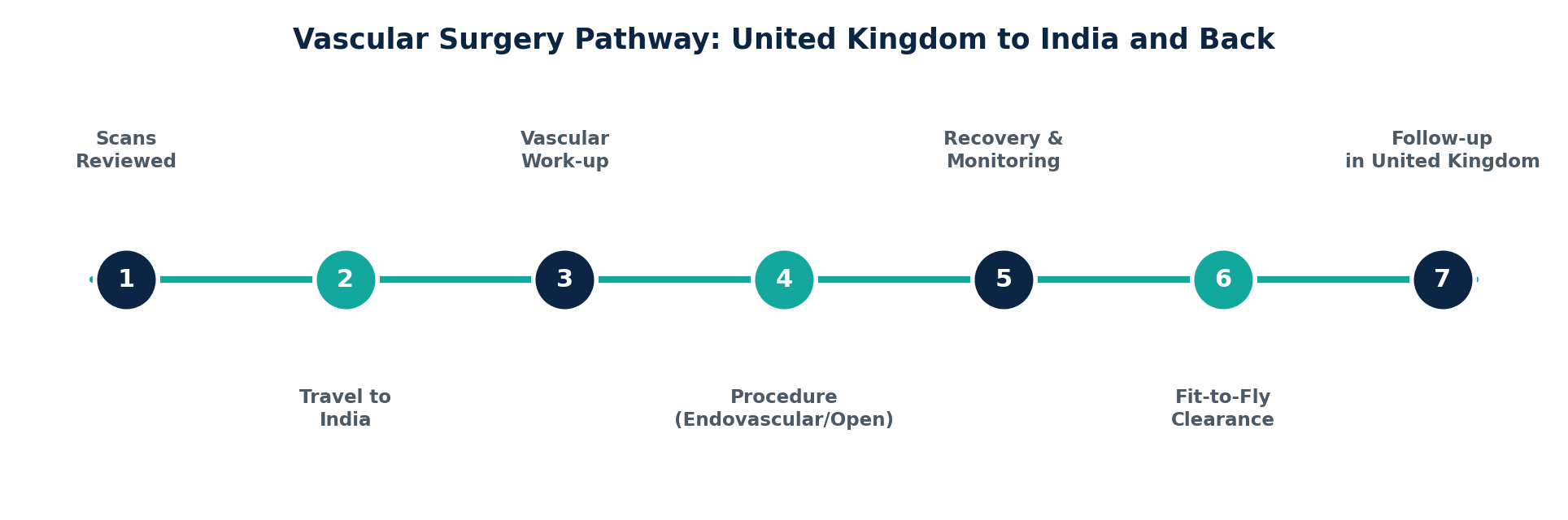
The appropriate period depends heavily on the procedure. A straightforward endovascular procedure may allow travel home within a few days, while open aortic surgery or complex bypass surgery requires a longer stay for wound healing and monitoring before the treating team confirms fitness to travel. A United Kingdom patient should not book an inflexible return flight based solely on the expected hospital discharge date.
Flying Back to the United Kingdom After Vascular Surgery
- Fit-to-fly clearance from the treating vascular surgeon
- Wound and circulation assessment before flying
- Walking during the journey to reduce clot risk
- Hydration
- Blood-clot prevention measures
- Compression stockings if appropriate
- Medication timing, including blood thinners
- Airport wheelchair assistance if needed
Patients recovering from aortic surgery or with a new stent graft may need specific clearance regarding cabin pressure changes and activity restrictions before flying.
What Medical Information Should You Take Back to the United Kingdom?
- Discharge summary
- Operative report
- Final diagnosis
- Relevant imaging (ultrasound/CT/MR angiography)
- Details of any stent, graft, or device implanted
- Laboratory results
- Medication list, including any blood thinners
- Follow-up and surveillance schedule
- Emergency warning signs
- Treating vascular surgeon’s contact/follow-up pathway
Follow-Up After Returning to the United Kingdom
- Wound assessment
- Doppler ultrasound or CT surveillance where relevant (especially after aneurysm repair)
- Blood tests, including anticoagulation monitoring if on blood thinners
- Risk-factor management review
- Assessment of graft or stent patency over time
- Coordination with local physician for long-term cardiovascular risk management
How Successful Is This Surgery for United Kingdom Patients in India?
There is no meaningful single “success rate” for vascular surgery. Outcomes depend on the specific condition, the extent of disease, other cardiovascular risk factors, age, and overall health. The expected outcome of a straightforward varicose vein procedure cannot reasonably be compared with complex aortic aneurysm repair or bypass surgery in a patient with severe peripheral arterial disease. Patients should be cautious about websites offering one universal success percentage.
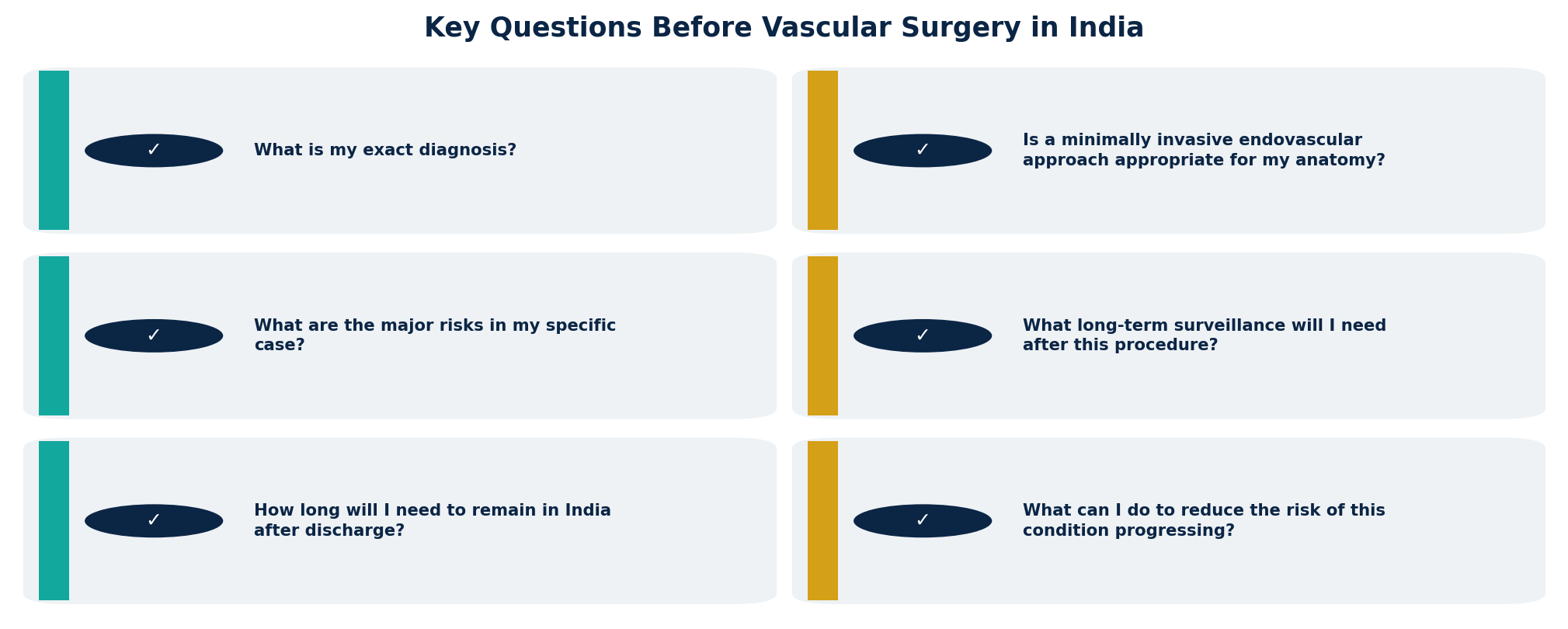
Questions United Kingdom Patients Should Ask Before Agreeing to Surgery
- What is my exact diagnosis?
- Is a minimally invasive endovascular approach appropriate for my anatomy?
- What are the alternatives to surgery for United Kingdom patients in India?
- What are the major risks in my specific case?
- How frequently do you perform this exact procedure?
- What long-term surveillance will I need after this procedure?
- How long will I be hospitalised, and how long in India afterward?
- When will I be fit to fly back to the United Kingdom?
- What follow-up will I need after returning home?
- What can I do to reduce the risk of this condition progressing or recurring?
Vascular and Endovascular Surgery FAQs for United Kingdom Patients in India
For United Kingdom patients, can my scans be reviewed before I travel from the United Kingdom?
Often, yes. Digital imaging and reports can be reviewed remotely for an initial opinion, though a definitive plan usually requires in-person evaluation and sometimes further local imaging.
Does every narrowed artery need surgery for United Kingdom patients?
No. Many patients are managed with medication, exercise therapy, and risk-factor control, particularly in earlier-stage disease.
Is endovascular repair better than open surgery for an aneurysm for United Kingdom patients?
Not universally. It generally offers a faster recovery, but suitability depends on the aneurysm’s exact anatomy, and open repair may still be more durable in certain cases.
Are varicose veins just a cosmetic problem for United Kingdom patients?
Not always. They can cause pain, swelling, and skin changes, and in some cases lead to complications; treatment is usually recommended based on symptoms, not appearance alone.
For United Kingdom patients, how soon can I fly back to the United Kingdom?
There is no universal timeframe. Your vascular surgeon should clear you for travel based on wound healing, circulation, and overall recovery.
Key Takeaway for United Kingdom Patients
- Travelling from the United Kingdom to India for vascular or endovascular surgery is a significant decision.
- The most important step is establishing the correct diagnosis and determining whether intervention is genuinely required, and whether a minimally invasive endovascular approach suits your specific anatomy.
- For a United Kingdom patient, the treatment plan should also extend beyond the procedure itself to cover recovery in India, fitness for travel, ongoing cardiovascular risk-factor management, and a clear long-term surveillance pathway after returning home.
Sources & Further Reading
The following government and medical-authority resources provide independent, publicly available information on this topic:
- Aortic Aneurysm - Treatment
- Peripheral Artery Disease - Treatment
- About Peripheral Arterial Disease (PAD)
- Varicose veins
- Cardiovascular diseases (CVDs)
Hero photo: “Health Health - Stethoscope” by Formulate Health, via Wikimedia Commons, licensed CC BY 2.0.
Citation Block: Vascular and Endovascular Surgery for United Kingdom Patients in India
Quick reference for United Kingdom patients
| Topic | Information |
|---|---|
| Guide | Vascular and Endovascular Surgery for United Kingdom Patients in India — Complete Clinical & Surgical Guide |
| Overview | Vascular surgery covers procedures performed on the arteries and veins outside the heart and brain — including the aorta, the leg and arm. |
| Condition | No. |
| Warning Signs | Sudden severe abdominal or back pain (possible aneurysm rupture) |
| Open Surgical | Many conditions that once required large open incisions — including aortic aneurysms and arterial blockages — can now be treated from. |
| Risks Possible | Bleeding |
| Recovery Support | Supervised walking programmes for peripheral arterial disease |
| Flying Back | Fit-to-fly clearance from the treating vascular surgeon |
| Follow-Up Returning | Wound assessment |
| Authored and Reviewed by | Medical Experts at India Cardiac Surgery Team · 06-10-2026 |
United Kingdom Patients: Plan Your Vascular Surgery in India
Angioplasty, aneurysm repair or varicose vein treatment — get a FREE CONSULTATION and a US$ cost estimate today.